Think

Your path.
Your pace.

Every student moves at their own pace through teacher-guided, mastery-based academics. No one is held back by the class average. No one is pushed ahead before they're ready.

The Principle

Why the morning block works differently.

Most schools fill every hour with instruction. We don't. Deep learning requires focus, rest, and room to apply what you know.

The academic block runs in the morning: two hours of genuine cognitive work, personalised to each student. No padding. No whole-class instruction at the pace of the median. Each student is working at their own level, moving forward when they demonstrate mastery.

The afternoon is where that knowledge gets applied and extended, through projects, physical activity, outdoor work, and real engagement with the world. Students don't just learn about things. They do things.

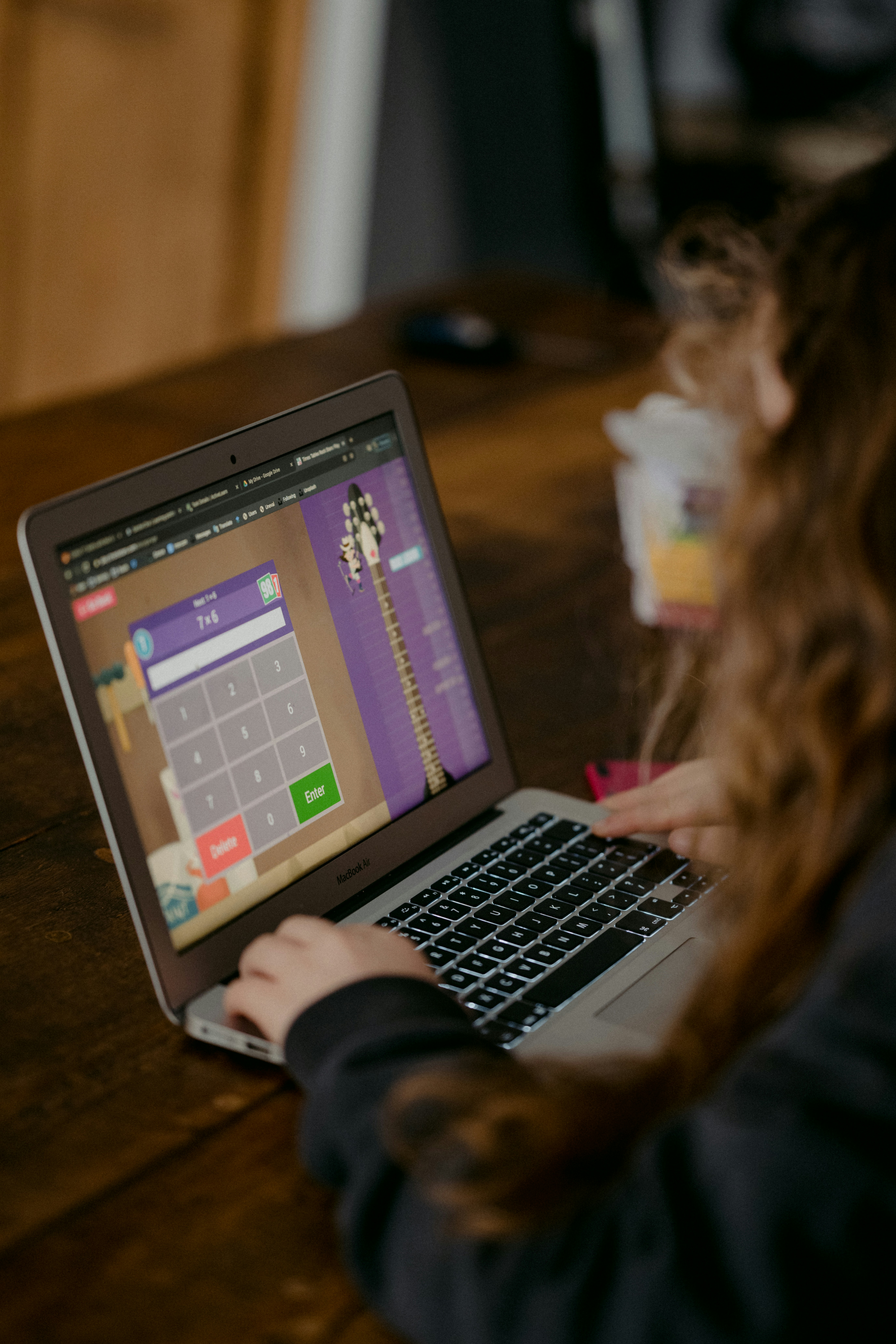
Student working through an adaptive learning programme on a laptop
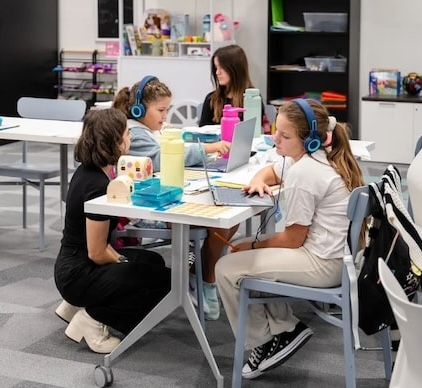
Students working alongside each other in a bright, naturally lit room
In Practice

This is not a computer lab.

The morning block takes place in a bright, naturally lit room, designed to feel like a place of work - not a screen room. Students sit alongside each other, not in rows facing forward. The room stays social.

The session runs in focused intervals of roughly twenty minutes, with breaks in between. Those breaks aren't passive: students compare problems, discuss what they've been working on, and often step outside. The rhythm is closer to a study group than a solo session.

When a student is stuck, they don't wait and they don't struggle alone. Teachers circulate throughout, and students who need more support move into a small-group or one-on-one session with a teacher. The adaptive tools handle pacing and correction. The teachers handle everything else.

Mastery Learning

No student moves on until they're ready.

In a conventional classroom, the teacher sets a pace and everyone moves together. Students who understand quickly are held back. Students who need more time are pushed forward before they're ready. Both groups are poorly served.

At Telos, each student progresses through the curriculum at their own level. A concept isn't ticked off until it's genuinely understood: demonstrated, not just attempted. When a student masters something, they move on. When they need more time, they get it. Gaps don't accumulate.

The second half of what makes this work is feedback. Adaptive tools now deliver what historically only one-on-one tutoring could: immediate correction, pacing that matches the learner, and skills that resurface at increasing intervals after they've been learned. A concept grasped shallowly will start to slip when it reappears weeks later - the system catches that before it becomes a gap. Review problems also arrive in mixed batches across topics, so students can't rely on context to guide them. Real understanding shows up when the right approach has to be chosen from scratch.

Young child climbing stone steps outdoors, seen from behind
The Evidence

We know what works already. We just haven't scaled it. Yet.

In 1984, Benjamin Bloom published findings showing that students taught one-on-one using mastery techniques outperformed 98% of their conventionally taught peers. He called this the “2 sigma problem”, not because the finding was in doubt, but because no one had found a way to deliver it at scale. The chart below shows what the gap looks like. Drag the marker to see how a student at any ability level ranks under each instructional model.

Conventional Classroom1 teacher : 30 students
50th percentile
Mastery Classroom1 teacher : 30 students
16th percentile
Mastery Tutoring1 teacher : 1 student
<1st percentile
0% 100% Student achievement score

Each curve represents the achievement distribution of a group of students under one of three instructional methods from Bloom's 1984 research. As instruction improves, from conventional classrooms to mastery learning to one-on-one tutoring, the entire distribution shifts right: far more students reach high scores.

Curriculum & Accreditation

How we're thinking about structure.

Cambridge International is our leading framework because it is outcome-focused and leaves full methodological freedom. The mastery-based model is fully compatible with it. Students working through Cambridge pathways have recognised routes to universities in the UK, EU, US, and beyond.

We are pursuing Portuguese Ministry of Education authorisation as our first regulatory milestone. In parallel, we are evaluating Cambridge International registration and CIS accreditation as the next steps, with final decisions to be confirmed as the regulatory process progresses. Post-launch, we will target the IB Diploma Programme as a university pathway for students aged 17–18.

Portuguese language is a core part of the academic programme, not an optional extra. Students learn to read, write, and speak Portuguese as a named curriculum strand, reflecting where the school is and the community it belongs to.

Curriculum Cambridge International (under evaluation)
Accreditation target CIS (Council of International Schools)
Regulatory framework Portuguese Ministry of Education

The specific curriculum framework and accreditation pathway are subject to change as we complete regulatory research and validate demand with families. We will confirm our choices publicly before enrolment opens. See the Roadmap for current status.
The Other Pillars

Check out the other pillars.